Block Paving Patterns: Which Is Strongest?
By Elite Paving & Roofing Ltd, run by director Jerry Connors
45-degree herringbone is the strongest block paving pattern for a driveway, followed closely by 90-degree herringbone. Both lock each brick against its neighbours so tyres cannot push blocks forward or sideways when you brake, accelerate, or turn the steering wheel on the spot.
Stretcher bond and basket weave look neat on garden paths and patios, but neither gives enough mechanical interlock for regular car or van traffic. Laying the wrong bond on a driveway is one of the main reasons we get called out to fix sunken wheel tracks and spreading joints a couple of winters later.
Quick Rule of Thumb on Site
Vehicles driving or turning? Use 45-degree or 90-degree herringbone with 60mm blocks on a compacted MOT Type 1 sub-base. Foot traffic only? Stretcher bond or basket weave on 50mm blocks is fine.
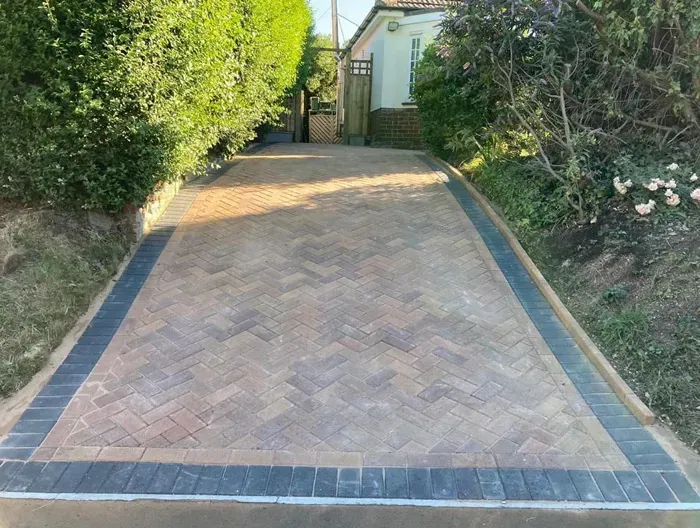
Local Know-How for Canterbury & Kent
- For a house in England, a new or replacement front-garden driveway of any size does not need planning permission if it uses permeable or porous surfacing (for example gravel, permeable concrete block paving or porous asphalt), or if the rainwater is directed to a lawn or border to drain naturally. If the surface is more than five square metres, planning permission is needed for a traditional impermeable driveway that does not provide for the water to run to a permeable area. The rule applies to houses, not flats, and only to the front garden. Permeable block paving over an open-graded base, or draining to a lawn or border, is the usual way a front driveway stays within permitted development. Source: Planning Portal, gov.uk guidance.
“Jerry and his team installed block paving and fences in my driveway. Communication was excellent from the start and they installed the new driveway in 2 days.”
Related: Block paving · Our work in Canterbury
How the Four Main Patterns Handle Vehicle Weight
Standard concrete pavers are not glued down. They work as a flexible pavement: weight passes from the tyre, into the block, sideways through the kiln-dried jointing sand into the surrounding blocks, and down into the sub-base. The laying pattern controls how well that sideways load spreads out.
| Pattern | Vehicle Strength | Best Used For | Wastage & Cutting |
|---|---|---|---|
| 45-Degree Herringbone | Strongest | Driveways, turning areas, slopes, heavy SUVs & vans | Higher edge cuts (allow ~8–10% extra blocks) |
| 90-Degree Herringbone | Very Strong | Straight driveways & parking bays | Moderate edge cuts (allow ~5–7% extra blocks) |
| Stretcher (Running) Bond | Low–Moderate | Paths, patios, light straight-in drives (laid across traffic only) | Lowest cutting & fastest to lay |
| Basket Weave | Weakest | Garden paths, courtyards, decorative patio borders | Low cutting on square areas |
1. 45-Degree Herringbone
Because every brick sits at 45 degrees to the road and house wall, a rolling tyre never hits a long straight joint line. Braking forces and power steering twists are broken up in two directions at once.
If you have a steep drive, a tight turn off the road, or park a heavy van or electric car, 45-degree herringbone is the safest choice. The trade-off is extra time on the diamond saw cutting triangular infills along every border edge.
2. 90-Degree Herringbone
90-degree herringbone locks together almost as tightly as 45-degree. The bricks still stagger at right angles to one another, stopping individual pavers from sliding forward when you brake.
It suits square or rectangular driveways where straight lines match the house brickwork. Along square boundaries, half-bricks fit neatly into the border course with fewer awkward angled offcuts, keeping material waste slightly lower.
3. Stretcher Bond (Running Bond)
Stretcher bond lays blocks in straight rows like a standard brick wall. It looks tidy on a narrow path, but on a driveway it has a weakness: continuous long joints. If the rows run parallel to the car's wheels, tyres gradually push the rows apart and sink between them.
If a customer really wants stretcher bond on a straight single-car drive, the rows must run across the width of the drive rather than down its length—and even then, turning the steering wheel while stationary can still twist blocks out of line.
4. Basket Weave
Basket weave pairs two blocks side by side, alternating horizontal and vertical squares. It suits cottage gardens and seating areas, especially with tumbled or rumbled blocks.
Under a car, however, each square pair acts like a loose tile with straight joints all around it. Once heavy tyres cross the edge of a pair repeatedly, the blocks rock, sand drops out of the joints, and the surface starts dipping. Keep basket weave for foot traffic only.
Why the Pattern Alone Won't Stop Wheel-Track Rutting
Even the tightest 45-degree herringbone will sink in wheel tracks if the groundwork underneath is rushed. On jobs where we are called to rip up and re-lay a failing drive, the blocks themselves are rarely broken—the failure is almost always underneath them or at the edges.
1. Concrete-Haunched Edge Kerbs
Block paving relies on sideways friction. If the outer edge of the drive is only pushed up against soil, timber sleepers, or loose mortar, the weight of a parked car slowly pushes the perimeter blocks outward. Once the edge moves by even 10mm, the whole herringbone grid loosens and ruts form down the tyre tracks. Every perimeter edge needs proper kerb blocks or a soldier course set on a 100mm concrete bed and haunched up the back with strong C20/C25 concrete.
2. Sub-Base Depth and Layer-by-Layer Compaction
Across Kent we dig into everything from sticky clay to chalky soil. You cannot skim two inches of topsoil off, tip a bulk bag of ballast over it, and expect it to hold a two-tonne car. A driveway needs excavating down to firm ground—typically 200mm to 250mm below finished level—lined with a non-woven geotextile membrane so subsoil clay does not pump up into the stone. We then compact at least 150mm of MOT Type 1 crushed limestone in two separate lifts using a heavy vibrating plate, not one lazy pass over the top.
3. Screed Sand Thickness and Kiln-Dried Jointing
Sharp washed grit sand should be screeded to a uniform 30mm–40mm once compacted. A common shortcut is using sand 75mm or 100mm deep to make up for a shallow stone sub-base; that deep sand bed compresses unevenly under tyres and creates ruts within months. At the end of the job, kiln-dried silica sand is brushed into the joints and vibrated down with a plate compactor until the blocks wedge tight. Building sand must never be used—it holds moisture and washes straight out.
4. Surface Drainage and Front Garden Rules
Standing water softening the sand bed is another hidden cause of rutting. Good falls away from the house and linear Aco channels keep the bedding layer dry. If you are paving more than five square metres of a front garden, it is also worth checking the Planning Portal front garden paving rules—using permeable blocks over an open-graded Type 3 stone base or draining water into a lawn border usually keeps the work within permitted development.
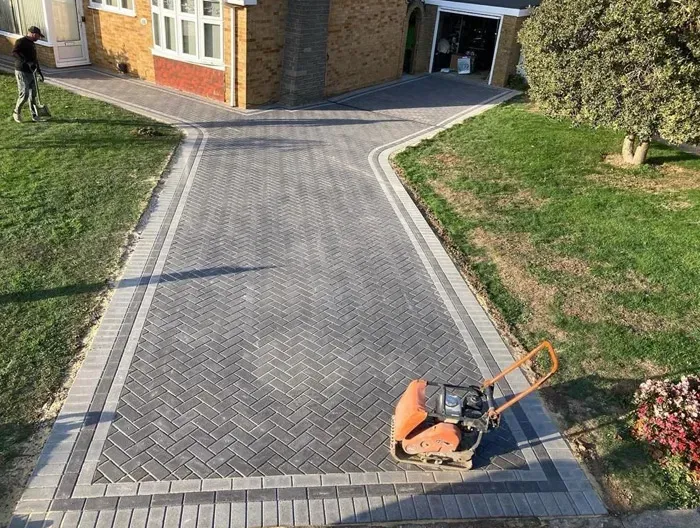
Final Compaction Matters
Vibrating kiln-dried sand into the joints with a whacker plate locks the herringbone pattern together and settles the blocks evenly into the sharp sand bed.
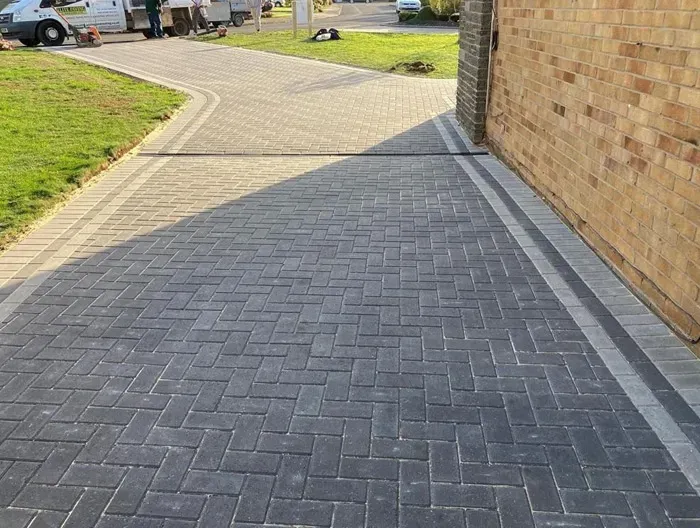
Border & Channel Drainage
Concrete-haunched borders stop edge spread, while recessed channel drains keep rainwater from saturating the sand bed beneath the blocks.
What Drives Cost—and When Can You Just Repair?
Most homeowners assume the block colour or brand sets the price, but on site it is the preparation, muck-away, and cutting time that move the quote most. A 45-degree herringbone driveway takes slightly longer to cut in around curves, manhole covers, and borders than 90-degree herringbone or stretcher bond, and you need to order roughly 8–10% extra blocks to cover angled offcuts.
If you already have a paved drive with sunken wheel tracks, you do not always need to pay for a brand-new installation. When the blocks are sound and the dip is limited to a single tyre path or a burst pipe trench, lifting that section, topping up and compacting the Type 1 stone, re-screeding fresh grit sand, and relaying the existing bricks is often enough.
Full replacement makes more sense when water pools right across the drive, the original installer skipped the geotextile membrane so mud is pumping through the joints, or the perimeter kerbs have kicked outward. When we quote for block paving work around Canterbury, we lift a couple of edge bricks on the site visit if needed so we can tell you honestly whether a localised repair will hold or if the base needs starting again.
What to Look Out for on Installation Day
Whether you use our crew or another local contractor, checking these five things while the work is open saves a lot of trouble later:
- 1 Block thickness: Check the packs arriving on the pallet are 60mm thick (or 80mm for heavy commercial vehicles), not 50mm patio pavers.
- 2 Geotextile membrane: Make sure terram fabric is laid across the bare earth before the crushed stone goes in, stopping clay and gravel from mixing.
- 3 Clean cut-ins: Border cuts should sit tightly with a consistent 2–3mm joint—never wide gaps stuffed with slivers of brick.
- 4 DPC height: Finished paving along house walls must stay at least 150mm (two brick courses) below your damp-proof course unless an Aco drain sits right against the wall.
- 5 Kiln-dried sand & rubber mat: Dry bagged silica sand should be swept in on a dry surface, and a rubber sole pad should be fitted to the whacker plate if your blocks have a smooth or tumbled finish.
Need Advice on a New Driveway or Sunken Wheel Tracks?
Speak directly with the team at Elite Paving and Roofing LTD. We cover Canterbury and surrounding Kent towns, inspect the ground properly before quoting, and back new installations with our 5-year guarantee.
Related Services & Guides
Explore our paving services and practical homeowner guides.
Block Paving Canterbury
Elite Paving & Roofing LTD offers premium block paving installations and repairs in Canterbury & Kent. Durable, high-quality driveways and patios backed by a 5-year guarantee. Free quotes!
Read more →Do I Need Planning Permission for a Driveway?
Check if a new driveway in Canterbury or Kent needs planning permission: the five-square-metre rule, permeable surfaces and KCC dropped kerbs.
Read more →How Much Does a New Patio Cost?
Get realistic per-square-metre patio costs. Learn how excavation, sub-base depth, drainage and waste removal drive prices so you can compare quotes.
Read more →How Long Does Garden Landscaping Take?
Realistic timescales for garden landscaping in Kent, and how access, clay soil, wet weather and a KCC skip licence affect the start date.
Read more →Do You Need Scaffolding for Roof Work?
Find out when roof work requires scaffolding rather than ladders, how long it stays up, and when you need a Kent pavement licence.
Read more →Resin-Bound vs Resin-Bonded: What's Different?
Compare permeable resin-bound and non-porous resin-bonded driveways, and what the front-garden five-square-metre drainage rule means in Kent.
Read more →How Long Does a Tarmac Driveway Last?
How long a tarmac driveway lasts, what makes edges crumble, and when a front-garden tarmac drive in Kent needs planning permission.
Read more →What Is the Best Gravel Size for a Driveway?
Whether 14mm or 20mm angular shingle is best for a driveway, plus depth, membranes, grids, and why gravel can be permitted development.
Read more →Is Porcelain Paving Slippery When Wet?
Why outdoor R11 porcelain keeps its grip in the rain, unlike indoor tiles, and how a full mortar bed keeps slabs secure.
Read more →Should You Seal an Indian Sandstone Patio?
Whether to seal an Indian sandstone patio against lichen, stains and frost, when to wait after laying, and matte versus colour-enhancing sealers.
Read more →Why Do Patio Slabs Come Loose?
Why patio slabs rock or sink (spot-bedding, frost heave and failed pointing), and how re-bedding and repointing fix it.
Read more →Does Artificial Grass Drain Properly in Rain?
Learn how perforated backing, granite dust, and a Type 1 sub-base drain heavy rain on Kent clay, plus how to keep pet lawns puddle- and odour-free.
Read more →Wooden vs Concrete Fence Posts: Which Lasts?
Timber versus concrete fence posts for rot and wind, and the Planning Portal 1-metre / 2-metre height rules for fences in England.
Read more →Signs Your Chimney Needs Repointing or Flashing
Signs of chimney trouble (lifted lead, cracked flaunching, loft damp), and when chimney work in a Canterbury conservation area needs permission.
Read more →Can Pressure Washing Damage Paving or Stone?
How high-pressure jet washing can pit sandstone and strip pointing, and safer rotary cleaning and re-sanding methods.
Read more →How Soon Can You Walk on and Mow New Turf?
How soon you can walk on and mow new turf, how to check it has rooted, and watering and first-cut tips.
Read more →Can You Fix a Leaking Roof From Inside the Loft?
Why internal sealants and spray foam can trap moisture in a loft, and when a roof repair in Kent needs Building Regulations approval.
Read more →Can You Put a New Flat Roof Over Old Felt?
When to overlay or strip an old felt flat roof, the risks of trapped damp, and the Planning Portal 25% envelope and 50% roof rule.
Read more →Why Is Rainwater Dripping Behind My Gutters?
Why rainwater drips behind apparently clear gutters (perished eaves felt, missing trays and sagging brackets), and how to put it right.
Read more →Do Gutter Guards and Hedgehogs Actually Work?
Whether mesh gutter guards and brush hedgehogs actually help with leaves, moss and roof grit, and when hand clearing is better.
Read more →