Wooden vs Concrete Fence Posts: Which Lasts?
By Elite Paving & Roofing Ltd, run by director Jerry Connors
If you want the longest-lasting boundary fence with the least hassle later on, steel-reinforced slotted concrete posts win every time—routinely lasting 25 to 30 years or more. Even decent pressure-treated UC4 timber posts usually start softening at ground level after 8 to 15 years in damp Kent soil.
That does not mean concrete is automatically right for every garden. Timber still has a proper place on sloped plots, tight boundaries, and traditional featheredge runs where concrete slots look clunky. Here is how both options actually hold up on site once they are in the ground.
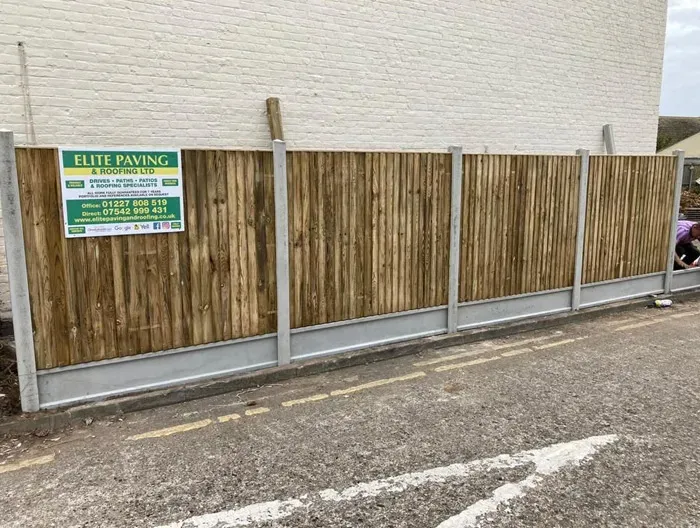
Closeboard fencing set into slotted concrete posts with concrete gravel boards keeps every piece of timber clear of wet ground.
Local Know-How for Canterbury & Kent
- In England you will not normally need planning permission for a new or altered fence if it is no more than one metre high next to a highway used by vehicles (or its footpath), or two metres high elsewhere, and the height of an already taller fence is not increased. That allowance can be removed by an Article 4 direction or a planning condition, and in a conservation area you might need permission to take a fence down. Source: Planning Portal, Canterbury City Council.
“Jerry done an excellent job on my back garden fence and also installed a new gate.”
Related: Fencing · Our work in Canterbury
Quick Side-by-Side Comparison
Most homeowners compare posts on price alone, which can be a false economy if you end up digging out snapped timber posts ten winters down the line. Here is how they stack up side by side.
| Factor | Slotted Concrete Posts | Pressure-Treated Timber Posts |
|---|---|---|
| Typical Lifespan | 25 to 30+ years (cannot rot) | 8 to 15 years depending on soil drainage and timber grade |
| Ground-Level Rot | Immune to fungal decay and damp soil | Vulnerable at the wet/dry collar where soil meets air |
| Wind Stability | Very stiff; resists snapping in winter gales | Strong when new, but weakens fast once decay starts |
| Gravel Boards | Slots neatly hold 150mm or 300mm concrete boards | Usually paired with timber gravel boards (still rot eventually) |
| Replacing Panels Later | Lift the old panel out from the top and slide a new one in | Fixed with screws/nails; rotten posts need digging out or spurring |
| Upfront Supply & Fit Cost | Higher material and labour cost (heavy two-person lift) | Lower upfront price and quicker to cut on slopes |
1. Ground-Level Rot: Why Timber Fails at the Collar
When we get called out to a blown-down wooden fence, the top five feet of the timber post are nearly always bone-dry and solid. The failure almost always happens in the first 100mm above and below the soil line. That band gets repeated wetting, oxygen, and soil fungi—the exact mix timber needs to decay.
Using proper UC4 ground-contact treated posts (100mm x 100mm minimum, never thin 75mm posts for a 6ft fence) slows that process down, as does trowelling the concrete footing into a gentle slope away from the wood so rainwater cannot pool against the grain. Even then, heavy clay gardens or shady borders bordered by flower beds stay damp for months at a time.
Concrete posts simply remove that weak point. Because they contain internal steel reinforcement bars cast inside dense concrete, damp soil and wet bark chippings cannot rot them. The main thing to watch out for with concrete is buying cheap, poorly compacted posts: if frost water gets into hairline cracks and reaches the steel rebar, the concrete can spall over time. Good-quality wet-cast or semi-dry vibrated posts avoid that issue.
2. Wind Stability & Post Depth
A standard 6ft (1.8m) solid overlap or closeboard panel acts like a sail in a winter gale. Around exposed stretches of East Kent—coastal gardens catching sea gusts or open plots backing onto farmland—wind loading is what tests a fence properly.
Regardless of whether you pick wood or concrete, post depth makes or breaks stability. For a 6ft panel with a 6-inch gravel board, we always use an 8ft (2.4m) post and dig a minimum 600mm (2ft) deep hole—deeper in loose, sandy, or made-up ground. Anyone quoting to concrete 7ft posts into shallow 450mm holes is setting the fence up to lean after the first heavy storm.
Because slotted concrete posts are rigid and heavy, they do not snap halfway up like an ageing wooden post. One small trade detail worth knowing: wooden panels sit slightly loose inside concrete slots so they can expand when wet. Without wooden wedges or stainless rattle clips tucked inside the channel, panels will bang against the concrete all night in high winds. Fitting wedges takes two minutes and stops the noise completely.
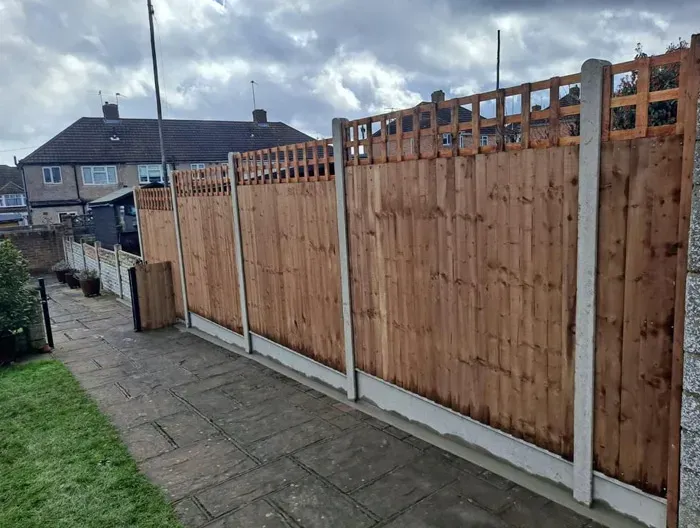
3. Gravel Boards: The Part That Saves Your Panels
Whether you choose concrete or timber posts, never let the bottom edge of a fence panel sit directly on soil, turf, or paving where splashback sits. That is what rots out the bottom rail of a fence years before the upper slats fail.
With slotted concrete posts, a 150mm (6-inch) or 300mm (12-inch) concrete gravel board drops straight into the base of the slot. It gives you a solid, rot-proof plinth that stops dampness wicking up into the wooden panel above, keeps pets from digging underneath, and shrugs off lawnmower wheels and strimmer cord.
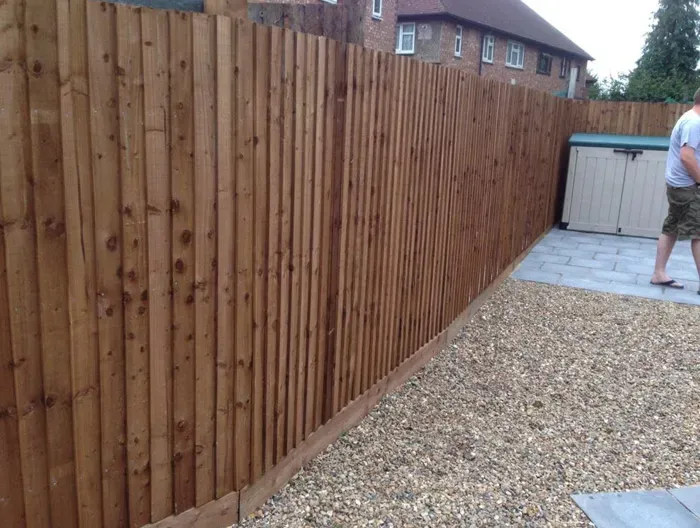
With wooden posts, you can still fit a 150mm x 22mm treated timber gravel board screwed across the bottom. It will eventually need replacing, but swapping out one sacrificed timber board every decade is far cheaper than replacing the whole featheredge run above it.
4. Future Panel Replacement & What Drives the Cost
Upfront, concrete posts and concrete gravel boards cost roughly 25% to 40% more than a standard timber post setup. The materials cost more, and because an 8ft concrete post weighs around 40–50kg, it takes two people to safely carry, plumb, and set each post without straining or chipping edges.
Where concrete pays you back is ten or fifteen years later. Timber panels do not last forever, even when kept off the ground. With slotted concrete posts, replacing a storm-damaged or faded panel is a straightforward job: slide the old panel straight up out of the grooves and drop the new one in. The posts stay put, undisturbed in the ground.
By contrast, replacing wooden posts means breaking out heavy concrete footings with a breaker or digging bar, which often disturbs neighbouring shrubs, block paving, or patio edges. If only one or two timber posts have snapped in an otherwise sound run, our Canterbury fencing installation and repair team can often bolt a concrete repair spur alongside the old stump to buy you extra years without stripping the whole boundary. Once three or more posts are soft and leaning, though, a full replacement is usually better value.
5. Slopes, Tight Corners & When Timber Makes More Sense
Concrete posts are built around standard 1.83m (6ft) wide panels. On level gardens, they go in straight and crisp. On steeply sloping ground, however, slotted concrete posts have to be stepped down in sharp 150mm drops, which can leave triangular gaps underneath unless you build up gravel boards or sleeper edging to suit.
For sloped boundaries, awkward angles, or a continuous featheredge closeboard fence built stick-by-stick on site, wooden posts with arris rails let us follow the natural fall of the garden smoothly without steps. Many homeowners also prefer the warmer look of timber along patio seating areas or front gardens—especially if you are installing decorative hit-and-miss or slatted panels where grey concrete uprights would stand out.
One practical note before ordering taller posts: rear garden fences up to 2 metres (roughly 6ft 6in) normally fall under permitted development, while boundaries beside a public road or footpath are generally capped at 1 metre. If your property is in a conservation area or sits near a highway junction, check the Canterbury City Council planning permission guidance before specifying 9ft or 10ft posts.
Which Should You Pick for Your Garden?
If you are weighing up a quote right now, use your garden's exposure and layout to make the call rather than guessing.
Choose Slotted Concrete Posts If:
- ✓ Your garden catches strong winds across open fields, hills, or coastal gusts.
- ✓ Soil stays wet over winter, or flower beds and hedges sit hard against the fence line.
- ✓ You want to slide replacement panels in easily in 10–15 years without disturbing patios or turf.
- ✓ You are fitting standard 6ft panels along a mostly level boundary.
Choose Wooden Posts If:
- ✓ The garden is sheltered by neighbouring houses and drains well after rain.
- ✓ You have a steep slope or awkward corners where featheredge closeboard needs to follow the gradient.
- ✓ You want an all-timber look alongside decking, sleeper beds, or slatted screens.
- ✓ You need to keep upfront costs tighter—just insist on 100mm UC4 posts and a gravel board.
What Happens on Installation Day
When our crew arrives to replace a boundary, we strip out the old panels and break out any failed concrete footings first so new posts sit in fresh, solid ground rather than perched beside old rubble. We run a tight string line from corner to corner, check depths for drainage pipes or shallow cables, and dig every hole to at least 600mm.
Posts are levelled plumb, set in properly mixed concrete (or fast-set Postcrete where access is tight), and trowelled to shed water away from the post face. Once gravel boards and panels are fitted, we wedge any concrete slots so they do not rattle, sweep any paths or driveways clean, and take all old timber and broken concrete off site.
Not Sure Which Post Spec Suits Your Boundary?
Speak directly with Elite Paving and Roofing LTD. We can check your soil, slope, and exposure on site across Canterbury and give you a clear, written price for timber or slotted concrete posts with no pressure.
Related Services & Guides
← Back to all homeowner guidesFencing Canterbury
Elite Paving & Roofing LTD provides professional fencing installation, repair and gates in Canterbury & Kent. Durable, stylish fencing backed by local expertise.
Do I Need Planning Permission for a Driveway?
Check if a new driveway in Canterbury or Kent needs planning permission: the five-square-metre rule, permeable surfaces and KCC dropped kerbs.
How Much Does a New Patio Cost?
Get realistic per-square-metre patio costs. Learn how excavation, sub-base depth, drainage and waste removal drive prices so you can compare quotes.
How Long Does Garden Landscaping Take?
Realistic timescales for garden landscaping in Kent, and how access, clay soil, wet weather and a KCC skip licence affect the start date.
Do You Need Scaffolding for Roof Work?
Find out when roof work requires scaffolding rather than ladders, how long it stays up, and when you need a Kent pavement licence.
Block Paving Patterns: Which Is Strongest?
Compare herringbone, stretcher bond and basket weave for driveways in Canterbury and Kent, and how edges and a compacted base stop wheel rutting.
Resin-Bound vs Resin-Bonded: What's Different?
Compare permeable resin-bound and non-porous resin-bonded driveways, and what the front-garden five-square-metre drainage rule means in Kent.
How Long Does a Tarmac Driveway Last?
How long a tarmac driveway lasts, what makes edges crumble, and when a front-garden tarmac drive in Kent needs planning permission.
What Is the Best Gravel Size for a Driveway?
Whether 14mm or 20mm angular shingle is best for a driveway, plus depth, membranes, grids, and why gravel can be permitted development.
Is Porcelain Paving Slippery When Wet?
Why outdoor R11 porcelain keeps its grip in the rain, unlike indoor tiles, and how a full mortar bed keeps slabs secure.
Should You Seal an Indian Sandstone Patio?
Whether to seal an Indian sandstone patio against lichen, stains and frost, when to wait after laying, and matte versus colour-enhancing sealers.
Why Do Patio Slabs Come Loose?
Why patio slabs rock or sink (spot-bedding, frost heave and failed pointing), and how re-bedding and repointing fix it.
Does Artificial Grass Drain Properly in Rain?
Learn how perforated backing, granite dust, and a Type 1 sub-base drain heavy rain on Kent clay, plus how to keep pet lawns puddle- and odour-free.
Signs Your Chimney Needs Repointing or Flashing
Signs of chimney trouble (lifted lead, cracked flaunching, loft damp), and when chimney work in a Canterbury conservation area needs permission.
Can Pressure Washing Damage Paving or Stone?
How high-pressure jet washing can pit sandstone and strip pointing, and safer rotary cleaning and re-sanding methods.
How Soon Can You Walk on and Mow New Turf?
How soon you can walk on and mow new turf, how to check it has rooted, and watering and first-cut tips.
Can You Fix a Leaking Roof From Inside the Loft?
Why internal sealants and spray foam can trap moisture in a loft, and when a roof repair in Kent needs Building Regulations approval.
Can You Put a New Flat Roof Over Old Felt?
When to overlay or strip an old felt flat roof, the risks of trapped damp, and the Planning Portal 25% envelope and 50% roof rule.
Why Is Rainwater Dripping Behind My Gutters?
Why rainwater drips behind apparently clear gutters (perished eaves felt, missing trays and sagging brackets), and how to put it right.
Do Gutter Guards and Hedgehogs Actually Work?
Whether mesh gutter guards and brush hedgehogs actually help with leaves, moss and roof grit, and when hand clearing is better.