The 5-Square-Metre Front Garden Rule Explained
Back in 2008, rules were brought in across England to stop thousands of front gardens being concreted over and sending extra rainwater straight into Victorian street drains. When a whole street sheds water off hard paving at once during a heavy Kent downpour, road gullies back up fast.
Under the Planning Portal front garden paving rules, any new or replacement hard surface between the front of your house and the highway needs planning permission if it covers more than 5 square metres and is a traditional impermeable surface that does not let the water run to a permeable area, such as a lawn or border, as the gov.uk permeable surfacing guidance explains.
Five square metres is roughly the size of a small porch path—around 2 metres by 2.5 metres—so almost every car-sized driveway goes over that threshold. That does not mean you have to apply for planning permission; it just means we build the drainage properly so the water stays on your plot.
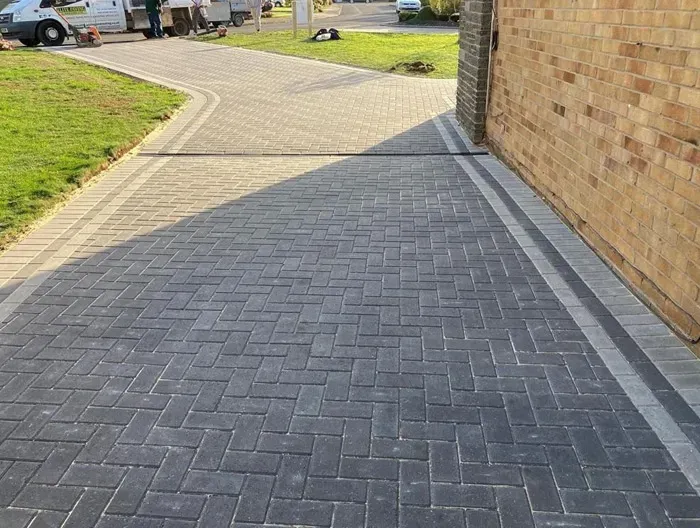
Permeable SuDS Options vs Standard Paving
To follow GOV.UK permeable surfacing guidance and Sustainable Urban Drainage Systems (SuDS) principles, you have two straightforward routes on site. Both avoid a planning application for a standard house:
1. True Permeable Surfaces
Water passes straight through the top finish and filters down into the ground below:
- Gravel or shingle: Naturally porous when laid over a permeable weed membrane and cellular grid.
- Permeable block paving: Laid with wider spacing nibs filled with 2–6mm grit instead of fine sand, over an open-graded MOT Type 3 sub-base.
- Permeable resin-bound: Only counts as SuDS-compliant when laid over porous asphalt or concrete—laying resin onto old non-porous tarmac stops it draining.
2. Directing Water to Your Own Garden
Standard tarmac, pattern-imprinted concrete, or regular herringbone blocks are still fine if the falls send water onto permeable ground on your property:
- Lawn or flowerbeds: The driveway is graded to fall gently towards a border or turf edge rather than the street.
- Channel drain to a soakaway: We fit linear Aco channels across the threshold and pipe them to a cellular crate soakaway buried at least 5 metres from house foundations.
What actually goes wrong on site: A lot of cheap quotes promise a "permeable" resin or block drive, then compact standard MOT Type 1 limestone dust underneath it. Type 1 packs down almost solid and holds water, especially on the heavy clay soil we hit around Fordwich and Sturry. For true permeable paving, we dig out to full depth and use clean, crushed Type 3 stone with zero fines so water can sit safely in the sub-base voids until it soaks away.
If you are weighing up finishes and sub-base depths, you can see how we build each surface on our Canterbury driveway installations page.
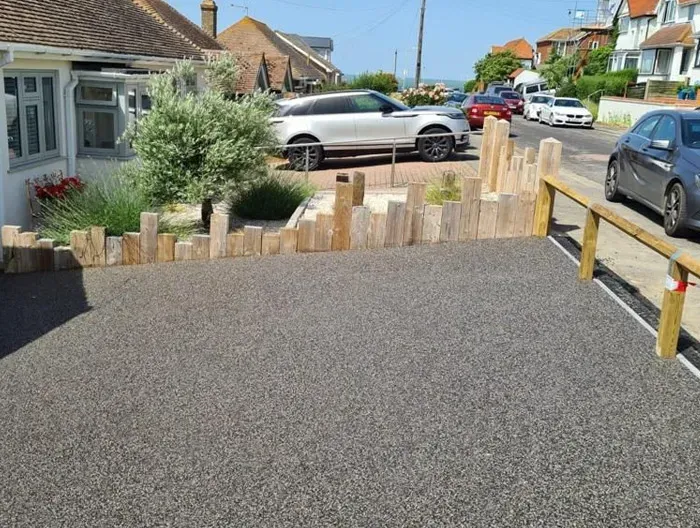
Conservation Areas, Listed Buildings & Flats
Permitted development rights are not a blanket pass for every property. Around Canterbury city centre and nearby villages like Chartham, Bridge, and Wingham, extra checks apply before we start digging:
- Conservation areas & Article 4 directions: Some streets have local restrictions removing permitted development rights—particularly if you are knocking down a front brick wall, removing a hedge, or changing traditional stone or cobbles for modern paving.
- Listed buildings: Any external work within the boundary of a listed property—even re-laying paving or changing gravel—can require Listed Building Consent.
- Flats and maisonettes: Permitted development rules for front gardens apply to single dwelling houses, not flats, converted apartments, or commercial premises.
- Back and side driveways: The five-square-metre rule specifically covers land between the front wall of the house and the street. Side and rear gardens have different rules, though you still must not flood a neighbour's plot.
If you are unsure whether your street sits inside a protected zone, run a quick check with Canterbury City Council's online planning checker before ordering materials. It takes ten minutes and prevents an enforcement notice later on.
Dropped Kerbs Need Separate Council Approval
This catches more homeowners out than anything else. Even when your front garden paving needs zero planning permission, you cannot legally drive across a public pavement without an approved vehicle crossover.
Because Kent County Council looks after the highways rather than Canterbury City Council, you have to submit a separate Kent County Council dropped kerb application before a crossover is installed. Note that if your property faces onto a classified road (an A, B, or C road), you will usually need planning permission for the access as well as the highways permit.
What drives the cost and timeline: Council approvals typically take 6 to 8 weeks. When we look at a new front drive, we check straight away for street light columns, telegraph poles, BT inspection covers, or highway trees in the verge—moving a lamp post or lowering a shallow gas main can easily double the crossover bill, so it is worth spotting early.
Replacing vs Repairing an Existing Driveway
You do not always need a full dig-out—and if you are repairing or relaying what is already there without increasing the impermeable area or sending water into the street, planning permission is rarely an issue.
When a repair makes sense: If the sub-base underneath is solid and only a few square metres of block paving have dipped around a manhole cover or tyre track, lifting those blocks, topping up and compacting the sharp sand bedding, and re-laying them is a half-day job. Likewise, sound concrete with minor surface flaking can sometimes be overlaid with resin-bound aggregate provided falls and damp-proof course heights allow it.
When full replacement is the honest call: If weeds are bursting through deep ruts, tree roots have heaved the base, or rainwater pools against the front wall of the house (above or close to your damp-proof course, which should always sit at least 150mm clear), patching the top will not fix it. A proper full replacement—usually taking 3 to 5 days depending on size—lets us set fresh falls, install Aco drainage, and compact a clean sub-base that will not sink under SUVs or delivery vans.
Quick Checklist Before Work Starts
- Measure the front area: Anything over 5m² needs permeable surfacing or on-site drainage.
- Check your damp-proof course: Finished paving should stay at least 150mm (two brick courses) below the DPC.
- Confirm property status: Check if you live in a conservation area, a listed building, or a flat.
- Sort the kerb first: Do not pay to pave a front lawn until you know Kent Highways will approve the dropped kerb.
- Verify waste disposal: Make sure whoever digs out your old garden soil and concrete holds a valid waste carrier licence and clears all spoil off site cleanly.