Is Porcelain Paving Slippery When Wet?
By Elite Paving & Roofing Ltd, run by director Jerry Connors
The short answer is no—provided you buy proper 20mm outdoor porcelain with an R11 anti-slip rating. Even in heavy rain, genuine exterior porcelain slabs give solid underfoot grip and are often safer than damp timber decking or smooth natural stone.
Where homeowners run into trouble is either buying indoor-grade tiles by mistake, or having slabs laid without proper drainage falls so rainwater puddles and turns to ice or green algae over winter. Below, we explain how slip ratings work and what actually keeps a porcelain patio safe underfoot on site.
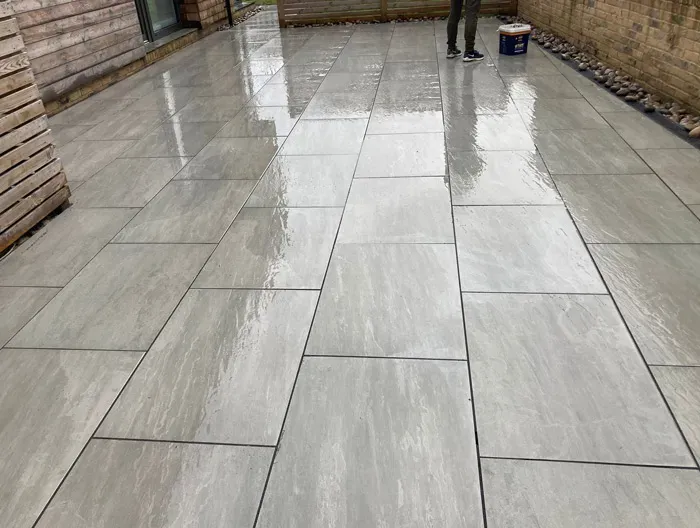
A newly washed R11 grey porcelain patio—textured to keep grip even when freshly hosed down.
Related: Porcelain patios · Our work in Canterbury
What the R11 Anti-Slip Rating Actually Means
Porcelain tiles are tested on an oiled ramp to measure how steep an angle a person wearing standard footwear can walk on before slipping. That gives the tile an “R” rating from R9 up to R13.
When you look closely at a 20mm outdoor R11 slab, it feels slightly grainy—almost like fine sandpaper—rather than glossy. That micro-texture breaks up surface water under your shoe so you do not aquaplane across the patio in a downpour, yet it is still smooth enough to sweep with a stiff broom or walk across barefoot in summer.
Kitchen & Hallway Tiles
Usually 8mm to 10mm thick with a smooth or polished glaze. Fine inside a dry house, but dangerously slick outside after a light shower and too thin to handle frost or garden furniture loads.
Bathrooms & Porches
Offers mild slip resistance for wet-room floors or sheltered verandas. Not recommended for open UK gardens exposed to heavy rain, fallen leaves, and winter frost.
20mm Exterior Porcelain
The industry standard for British patios, steps, and pool surrounds. Vitrified at high kiln temperatures so water absorption is below 0.5%, giving reliable wet grip and frost resistance all year round.
Why Proper Bedding & Drainage Matter Just as Much as the Slab
Even the best R11 slab will cause headaches if it is laid badly. Unlike concrete or Indian sandstone, vitrified porcelain barely absorbs any water at all. That is great for stain resistance, but it means ordinary sand-and-cement mortar will not suck into the back of the slab to hold it down.
1. Priming Slurry on Every Single Slab
Before each slab goes down, we brush a coat of cementitious priming slurry (a polymer-modified SBR bond bridge) across the entire underside. Without slurry primer, porcelain slabs often pop loose after their first hard frost because the mortar bed has nothing to grip onto.
2. Full Wet Mortar Beds—Never “Dot and Dab”
Every slab needs 100% full contact on a moist 4:1 sharp-sand-and-cement bed over a compacted MOT Type 1 sub-base. Spot-bedding (leaving five blobs of mortar under the corners and middle) leaves hollow voids underneath. Water collects in those voids, freezes, and cracks corners or makes slabs rock underfoot.
3. Correct Falls & Linear Drainage
Because porcelain does not soak up rainwater, every drop runs off the surface. We build a steady fall—typically 1:60 to 1:80—away from your house walls towards the lawn or an ACO channel drain. No standing puddles means no sheet ice in January and far less slippery algae in shaded corners.
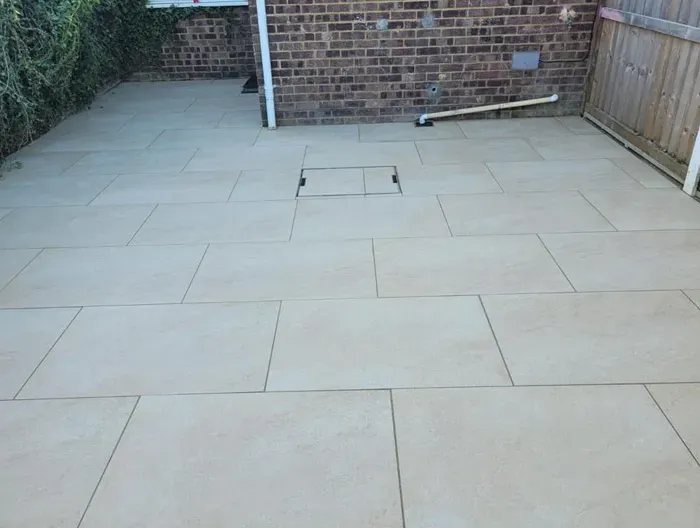
Spot a Shortcut Before It Happens
If you are getting quotes for a patio, ask the contractor two direct questions: “Are you priming the backs with SBR slurry?” and “Are you laying on a full bed rather than spots?” Any good groundworker will say yes straight away.
Speak to Our Team: 01227 953459What Happens on the Job & What Drives the Cost
Porcelain costs a little more to fit properly than standard concrete slabs, not because the job is complicated, but because you cannot rush the prep or cutting. Here is what actually affects the price and timescale for most gardens:
- Dig-out depth & spoil removal: Soft clay or turf needs excavating down to firm ground (usually 150mm or more) and carting away by skip or grab lorry before compacting at least 100mm of Type 1 crushed aggregate.
- Diamond wet-cutting: Porcelain is kiln-fired and hard. Standard stone blades chip the edges, so we use dedicated continuous-rim diamond porcelain blades with water suppression to get crisp cuts around drains and bay windows.
- Jointing compound: Narrow 3mm–5mm joints are filled with exterior porcelain grout or resin slurry rather than dry sand, stopping weeds and keeping the joint waterproof.
- Realistic timescale: An average 25–35m² back garden patio typically takes 3 to 5 working days from excavation to final wash-down and pointing, weather permitting.
If you are weighing up finishes or want to see how different colours look outside, take a look at our porcelain patio installations in Canterbury and across Kent to see what we supply and fit.
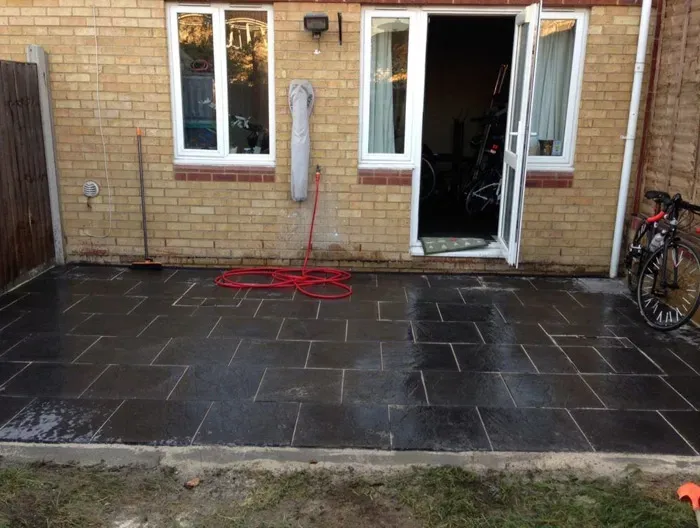
Repair or Full Replacement?
If one or two existing porcelain slabs have come loose because they were never primed, we can often lift, clean off the old mortar, apply SBR slurry, and re-bed them. However, if half the patio is rocking or holding water against the house damp-proof course, lifting and relaying on a proper sub-base is the only lasting fix.
Keeping Porcelain Safe in Winter & Shaded Gardens
Why Algae Barely Sticks to Porcelain
On porous sandstone or concrete, algae roots down into tiny pores and makes slabs green and slick every autumn. Because porcelain is non-porous, dirt and moss can only sit on the very top. A quick wash with warm soapy water and a stiff brush—or a gentle pass with a fan-nozzle pressure washer—lifts it straight off without needing harsh acids or sealers.
Frost & De-Icing Tips
Any outdoor surface will get icy if freezing rain lands on it overnight. Porcelain itself is frost-proof and will not spall or flake, so if you need to clear ice, use a plastic snow shovel rather than a metal spade (which can leave rust marks) and sprinkle sharp sand or a non-corrosive de-icer rather than heavy rock salt.
Planning a New Porcelain Patio or Fixing Loose Slabs?
We bring sample boards to your home, check your existing levels and drainage, and give you a clear, written quotation with a 5-year workmanship guarantee.
Related Services & Guides
Explore matching patio services and practical homeowner guides.
Porcelain Patios Canterbury
Transform your garden with stunning porcelain patios from Elite Paving and Roofing LTD. Durable, low-maintenance installations in Canterbury & Kent. Free quote today!
Read more →Do I Need Planning Permission for a Driveway?
Check if a new driveway in Canterbury or Kent needs planning permission: the five-square-metre rule, permeable surfaces and KCC dropped kerbs.
Read more →How Much Does a New Patio Cost?
Get realistic per-square-metre patio costs. Learn how excavation, sub-base depth, drainage and waste removal drive prices so you can compare quotes.
Read more →How Long Does Garden Landscaping Take?
Realistic timescales for garden landscaping in Kent, and how access, clay soil, wet weather and a KCC skip licence affect the start date.
Read more →Do You Need Scaffolding for Roof Work?
Find out when roof work requires scaffolding rather than ladders, how long it stays up, and when you need a Kent pavement licence.
Read more →Block Paving Patterns: Which Is Strongest?
Compare herringbone, stretcher bond and basket weave for driveways in Canterbury and Kent, and how edges and a compacted base stop wheel rutting.
Read more →Resin-Bound vs Resin-Bonded: What's Different?
Compare permeable resin-bound and non-porous resin-bonded driveways, and what the front-garden five-square-metre drainage rule means in Kent.
Read more →How Long Does a Tarmac Driveway Last?
How long a tarmac driveway lasts, what makes edges crumble, and when a front-garden tarmac drive in Kent needs planning permission.
Read more →What Is the Best Gravel Size for a Driveway?
Whether 14mm or 20mm angular shingle is best for a driveway, plus depth, membranes, grids, and why gravel can be permitted development.
Read more →Should You Seal an Indian Sandstone Patio?
Whether to seal an Indian sandstone patio against lichen, stains and frost, when to wait after laying, and matte versus colour-enhancing sealers.
Read more →Why Do Patio Slabs Come Loose?
Why patio slabs rock or sink (spot-bedding, frost heave and failed pointing), and how re-bedding and repointing fix it.
Read more →Does Artificial Grass Drain Properly in Rain?
Learn how perforated backing, granite dust, and a Type 1 sub-base drain heavy rain on Kent clay, plus how to keep pet lawns puddle- and odour-free.
Read more →Wooden vs Concrete Fence Posts: Which Lasts?
Timber versus concrete fence posts for rot and wind, and the Planning Portal 1-metre / 2-metre height rules for fences in England.
Read more →Signs Your Chimney Needs Repointing or Flashing
Signs of chimney trouble (lifted lead, cracked flaunching, loft damp), and when chimney work in a Canterbury conservation area needs permission.
Read more →Can Pressure Washing Damage Paving or Stone?
How high-pressure jet washing can pit sandstone and strip pointing, and safer rotary cleaning and re-sanding methods.
Read more →How Soon Can You Walk on and Mow New Turf?
How soon you can walk on and mow new turf, how to check it has rooted, and watering and first-cut tips.
Read more →Can You Fix a Leaking Roof From Inside the Loft?
Why internal sealants and spray foam can trap moisture in a loft, and when a roof repair in Kent needs Building Regulations approval.
Read more →Can You Put a New Flat Roof Over Old Felt?
When to overlay or strip an old felt flat roof, the risks of trapped damp, and the Planning Portal 25% envelope and 50% roof rule.
Read more →Why Is Rainwater Dripping Behind My Gutters?
Why rainwater drips behind apparently clear gutters (perished eaves felt, missing trays and sagging brackets), and how to put it right.
Read more →Do Gutter Guards and Hedgehogs Actually Work?
Whether mesh gutter guards and brush hedgehogs actually help with leaves, moss and roof grit, and when hand clearing is better.
Read more →