How Long Does Garden Landscaping Take?
By Elite Paving & Roofing Ltd, run by director Jerry Connors
For a straightforward back garden—clearing an old lawn, laying a 25m² patio, and putting down fresh turf—you are usually looking at 5 to 7 working days on site. A full garden overhaul with retaining walls, steps, fencing, drainage, and new paving typically takes 2 to 4 weeks from the first digger bucket to the final sweep-up.
That assumes decent access and dry ground. In reality, narrow side passages, heavy Kent clay, and spell-after-spell of rain can add several days to the calendar. Below is how a job actually breaks down day by day, and what slows things down on site.
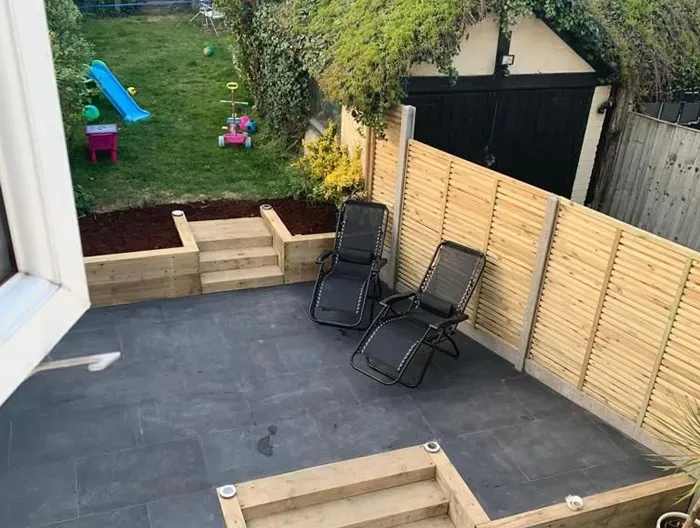
A complete back garden transformation with paving, sleeper steps, lawn, and boundary fencing typically runs two to three weeks.
Local Know-How for Canterbury & Kent
- If scaffold or a skip has to sit on a public road or pavement in the Canterbury district, you need a Kent County Council highways permit or licence before work starts. In Gillingham and the rest of Medway, Medway Council is the highway authority. That wait should be built into the pre-start programme if the skip or scaffold cannot sit on a private drive. Source: Kent County Council, Medway Council, Medway Council.
Related: Landscaping · Our work in Canterbury
Realistic Timeframes by Project Size
Every garden is different, but after years of digging out plots across Canterbury and East Kent, these are the honest on-site timescales we work to when quoting.
| Type of Garden Job | Typical Time on Site | What Is Included |
|---|---|---|
| New Lawn Only (Turf or Artificial) | 2 – 4 days | Stripping old turf, rotavating or excavating, bringing in screened topsoil or stone sub-base, levelling, and laying. |
| Standard Patio & Edging (20–30m²) | 4 – 6 days | Excavation, Type 1 MOT sub-base, drainage channel if needed, full mortar bed paving, and pointing once set. |
| Patio, Fencing & New Turf | 7 – 10 days | Full clearance, new concrete-post fencing, paved seating area, topsoil prep, and fresh lawn installation. |
| Sloped Garden with Walls & Steps | 2 – 4 weeks | Heavy muck-away, concrete footings, brick or sleeper retaining walls, tiered levels, drainage, paving, and turfing. |
Note: Timescales above cover working days on site. Lead times before start day also depend on material deliveries and whether any road permits are needed.
What Happens Stage by Stage
Good hard landscaping cannot be rushed at the bottom end. If the sub-base is thin or footings are green when you build on them, slabs rock and walls crack within a couple of winters. Here is how the work actually runs in order.
1. Clearance and Muck-Away
Everything old comes out first—broken concrete paths, rotten decking, overgrown shrubs, and old turf. People are always surprised by how much bulk comes out of a modest back garden once you dig down 150mm to 200mm for paving sub-bases.
If you have no front driveway for a skip and it has to sit on the road, you will need a Kent highways skip and scaffold licence arranged before day one, which usually adds 5 to 10 working days to pre-start planning. In Gillingham and the rest of Medway, the skip licence comes from Medway Council instead. Where road access allows, a grab lorry can clear loose soil piles in an hour and save waiting on skip swaps.
2. Groundworks, Drainage & Sub-Base
Once levels are marked out with laser and string lines, we dig down to firm ground, lay non-woven geotextile membrane where needed, and bring in Type 1 MOT stone. That stone is compacted in layers with a heavy plate compactor—not just skimmed over the top.
This is also when linear ACO drains, soakaways, recessed manhole covers, and ducting for garden lighting go in. Getting falls right away from the house brickwork takes patience, especially around awkward extensions or bay windows.
3. Retaining Walls, Steps & Fencing
Structural work goes in before fine paving. For brick garden walls or steps, concrete strip footings are poured and left to cure properly before the bricklayer starts laying courses. Skipping cure time is asking for movement.
Concrete fence posts and gravel boards are set in post-mix along tight string lines. A straight 15-metre boundary run with featheredge panels normally takes one to two days once the old fence and concrete spurs are dug out.
4. Paving, Pointing & Lawns
Porcelain slabs need priming with slurry on the back and laying on a solid, full mortar bed. Indian sandstone varies in thickness, so each flag is levelled individually by hand. Cutting neat corners around downpipes and drains takes time—especially on porcelain, which needs wet diamond blades.
Once the mortar bed sets firm, joints are pointed, and only then do we finish with topsoil, turfing, or artificial grass so nobody walks mud or cement dust across a brand-new lawn.
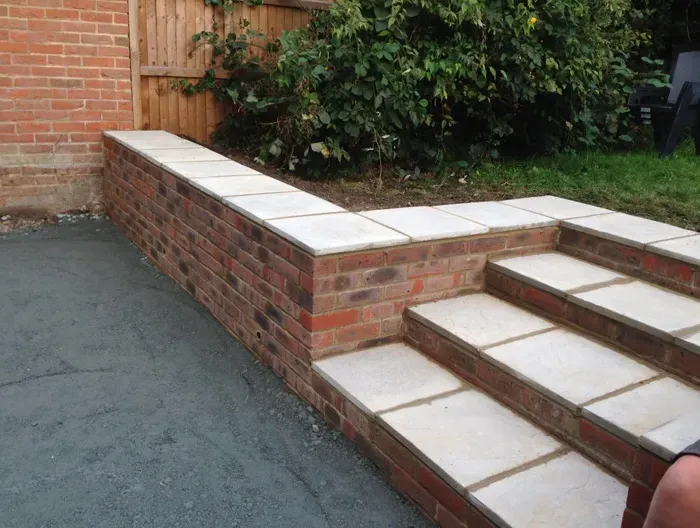
Why Walls and Steps Add Extra Days
Anything involving level changes needs concrete foundations, backfilling with clean stone behind retaining walls, and weep holes or drainage pipes so water pressure does not push the brickwork forward over winter.
If you are planning a multi-level layout through our garden landscaping service across Canterbury and Kent, we always factor footing cure days and drainage prep into the schedule from the start so there are no surprises halfway through.
What Slows a Landscaping Job Down on Site?
No two plots behave the same once you put a spade in. These are the four real-world site factors that most often turn a five-day job into an eight-day job.
Narrow Side Access
Our smallest micro-diggers and narrow-track dumpers need roughly 750mm to 800mm of clear width through a side gate—and enough turning room around downpipes or gas meter boxes. If a terraced house only has a tight alleyway or access through the house, every tonne of clay comes out in standard wheelbarrows, and every tonne of stone goes back in the same way. That alone can add 2 to 3 days of labour to a medium garden.
Heavy Clay Soil
Parts of Canterbury, Blean, and Herne Bay sit on sticky London clay. When it is wet, clay clings to digger buckets, clogs barrow tyres, and expands and shrinks with the seasons. On clay plots, you often have to dig a little deeper and put down a thicker compacted sub-base with geotextile membrane underneath so paving does not heave or sink.
Wet Weather and Frost
A light shower is fine for digging out, though it makes clay heavy. Steady rain stops bricklaying, washes cement out of fresh pointing, and ruins mortar beds. Worse still, walking over saturated topsoil to lay turf compacts it into mud, leaving you with a rock-hard, poorly draining lawn come summer. Frost below 2°C also halts mortar and concrete work—no honest tradesperson will lay slabs onto frozen ground.
Surprises Buried Underground
Until the turf or old slabs are lifted, nobody knows what previous owners buried. We regularly uncover 200mm-thick old concrete shed bases, shallow plastic water pipes laid just beneath the grass, tangled sycamore roots, or collapsed clay land drains that need redirecting before the new sub-base can go down.
Getting the Timing Right for New Turf
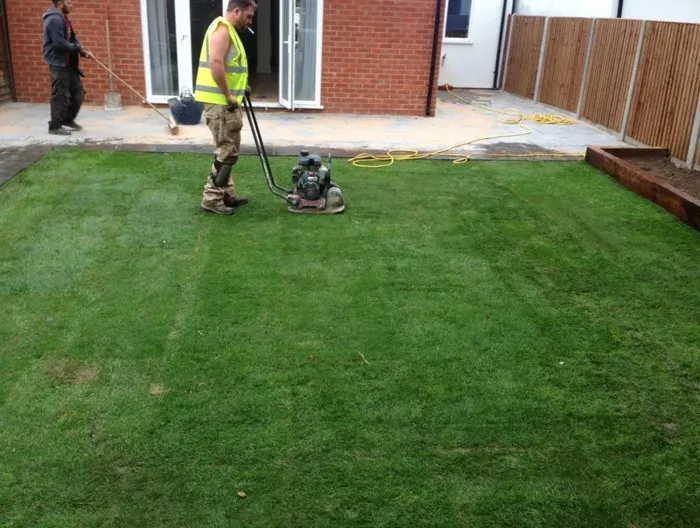
Turf is cut fresh to order and should be laid the same day it arrives on site, especially in warmer months when rolled turf heats up quickly. That is why we never order turf until the patio, walls, and topsoil levelling are completely ready.
Once laid, keep foot traffic off a new turf lawn for 2 to 3 weeks while the roots knit into the topsoil underneath. Artificial grass can be walked on straight away as soon as the final brush-up is done.
What You Can Do Before Day One
- 1. Move pots, garden furniture, trampolines, and washing lines clear of the work area.
- 2. Give next-door neighbours a heads-up if skips, grab lorries, or new boundary fence posts are going in.
- 3. Check that your outside tap works (needed for mortar mixing and cutting slabs) and mention any hidden manhole covers or septic tanks you know about.
- 4. Ensure waste removal is above board—any reputable contractor should hold a valid licence on the Environment Agency waste carrier register.
Want an Honest Timeframe for Your Garden?
We will come out to measure your garden, check side access and ground levels, and give you a clear written quote with a realistic start-to-finish schedule.
Related Services & Guides
← Back to all guidesLandscaping Canterbury
Elite Paving and Roofing LTD offers expert landscaping in Canterbury & Kent. From stunning patios and new turf to fencing and garden walls, transform your outdoor space with our guaranteed, professional service.
Read more →Do I Need Planning Permission for a Driveway?
Check if a new driveway in Canterbury or Kent needs planning permission: the five-square-metre rule, permeable surfaces and KCC dropped kerbs.
Read more →How Much Does a New Patio Cost?
Get realistic per-square-metre patio costs. Learn how excavation, sub-base depth, drainage and waste removal drive prices so you can compare quotes.
Read more →Do You Need Scaffolding for Roof Work?
Find out when roof work requires scaffolding rather than ladders, how long it stays up, and when you need a Kent pavement licence.
Read more →Block Paving Patterns: Which Is Strongest?
Compare herringbone, stretcher bond and basket weave for driveways in Canterbury and Kent, and how edges and a compacted base stop wheel rutting.
Read more →Resin-Bound vs Resin-Bonded: What's Different?
Compare permeable resin-bound and non-porous resin-bonded driveways, and what the front-garden five-square-metre drainage rule means in Kent.
Read more →How Long Does a Tarmac Driveway Last?
How long a tarmac driveway lasts, what makes edges crumble, and when a front-garden tarmac drive in Kent needs planning permission.
Read more →What Is the Best Gravel Size for a Driveway?
Whether 14mm or 20mm angular shingle is best for a driveway, plus depth, membranes, grids, and why gravel can be permitted development.
Read more →Is Porcelain Paving Slippery When Wet?
Why outdoor R11 porcelain keeps its grip in the rain, unlike indoor tiles, and how a full mortar bed keeps slabs secure.
Read more →Should You Seal an Indian Sandstone Patio?
Whether to seal an Indian sandstone patio against lichen, stains and frost, when to wait after laying, and matte versus colour-enhancing sealers.
Read more →Why Do Patio Slabs Come Loose?
Why patio slabs rock or sink (spot-bedding, frost heave and failed pointing), and how re-bedding and repointing fix it.
Read more →Does Artificial Grass Drain Properly in Rain?
Learn how perforated backing, granite dust, and a Type 1 sub-base drain heavy rain on Kent clay, plus how to keep pet lawns puddle- and odour-free.
Read more →Wooden vs Concrete Fence Posts: Which Lasts?
Timber versus concrete fence posts for rot and wind, and the Planning Portal 1-metre / 2-metre height rules for fences in England.
Read more →Signs Your Chimney Needs Repointing or Flashing
Signs of chimney trouble (lifted lead, cracked flaunching, loft damp), and when chimney work in a Canterbury conservation area needs permission.
Read more →Can Pressure Washing Damage Paving or Stone?
How high-pressure jet washing can pit sandstone and strip pointing, and safer rotary cleaning and re-sanding methods.
Read more →How Soon Can You Walk on and Mow New Turf?
How soon you can walk on and mow new turf, how to check it has rooted, and watering and first-cut tips.
Read more →Can You Fix a Leaking Roof From Inside the Loft?
Why internal sealants and spray foam can trap moisture in a loft, and when a roof repair in Kent needs Building Regulations approval.
Read more →Can You Put a New Flat Roof Over Old Felt?
When to overlay or strip an old felt flat roof, the risks of trapped damp, and the Planning Portal 25% envelope and 50% roof rule.
Read more →Why Is Rainwater Dripping Behind My Gutters?
Why rainwater drips behind apparently clear gutters (perished eaves felt, missing trays and sagging brackets), and how to put it right.
Read more →Do Gutter Guards and Hedgehogs Actually Work?
Whether mesh gutter guards and brush hedgehogs actually help with leaves, moss and roof grit, and when hand clearing is better.
Read more →