Should You Seal an Indian Sandstone Patio?
By Elite Paving & Roofing Ltd, run by director Jerry Connors
The short answer: Yes, in most UK gardens it is worth sealing Indian sandstone—especially if the patio sits under trees, takes heavy use around a barbecue, or uses lighter shades like buff, mint, or Raj Green. The catch is that you must wait until the stone and mortar bed have dried out properly, and you should use a breathable impregnating sealer rather than a cheap plastic-like lacquer.
Natural sandstone is tough, but it is also porous. Sealing won’t turn a patio into something you never have to sweep, yet it stops dirt, algae, and grease from soaking deep into the stone—making routine cleaning much quicker and helping prevent winter frost damage.
Quick Trade Summary
- Wait time after laying
- 8 to 12 weeks minimum in dry weather (longer if laid in autumn or winter)
- Best sealer type
- Breathable fluoropolymer or silane-siloxane impregnating sealer
- Typical re-seal interval
- Every 3 to 5 years depending on shade and foot traffic
- Drying weather needed
- At least 48 hours of dry, mild weather before and 24 hours after
Related: Indian sandstone patios · Our work in Canterbury
What Sealing Actually Protects Against (and What It Doesn’t)
Because Indian sandstone is a sedimentary rock, its surface is full of microscopic pores. Leave it bare in a damp Kent garden and it acts like a hard sponge. Sealing lines those pores so water and muck stay near the surface instead of working their way down into the slab.
Black Lichen & Algae
Black spot lichen anchors its roots inside damp stone pores, which is why pressure washing alone rarely shifts it cleanly. Sealing keeps the stone drier so spores struggle to take hold and wash off far more easily.
Food, Grease & Leaves
BBQ fat, red wine, bird droppings, and wet oak leaves leave dark tannin marks on raw sandstone within hours. A decent sealer buys you time to hose or wipe spills away before they stain.
Winter Frost & Flaking
When rainwater sits inside softer riven sandstone and freezes overnight, it expands and can flake thin layers off the top (spalling). Water-repellent sealers sharply reduce how much water sits in the surface.
Be realistic about upkeep: sealing does not make a patio self-cleaning. If a corner sits in permanent shade under overhanging conifers, moss and green algae will still grow on top of airborne dust and fallen leaves. The difference is that a sealed patio cleans back to fresh stone with a stiff brush or gentle wash rather than needing harsh chemicals every spring.
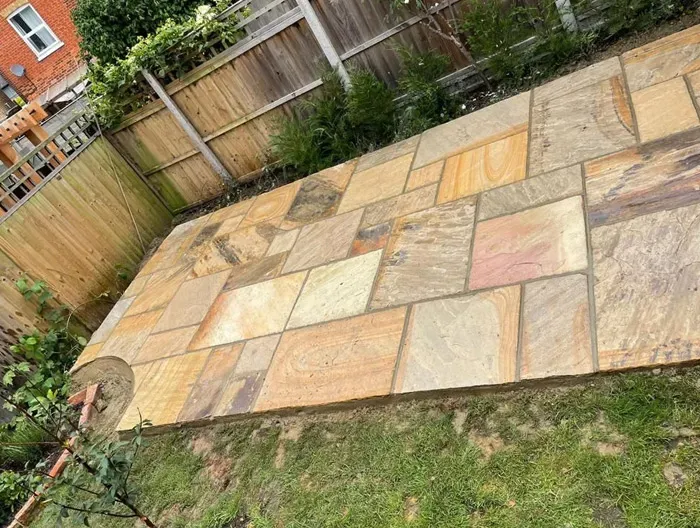
How Long Should You Wait After Laying?
The biggest mistake we see on site is someone sealing a brand-new patio within days of the pointing drying. Even when the surface looks dry to the eye, the wet mortar bed beneath the slabs holds litres of water and natural mineral salts.
As the patio dries out over its first couple of months, moisture draws those salts up through the stone and leaves chalky white patches on top—known in the trade as efflorescence. It is harmless and normally weathers away on its own with rain and sweeping. However, if you apply sealer too early, you trap that moisture and salt underneath. The result is cloudy white blotches locked inside the stone that are a real headache to strip out later.
Practical Waiting Rules
- Laid in spring or summer: Wait at least 8 to 12 weeks of mainly dry weather so construction moisture and efflorescence can escape cleanly.
- Laid in autumn or winter: Leave the stone bare over winter and seal it the following late spring once you get a proper dry spell.
- Check how it was bedded: During our Indian sandstone patio installations, slabs are laid on a full wet mortar bed over compacted Type 1 sub-base rather than hollow "spot dabs". A solid bed stops groundwater pooling under the flags, which means far less damp rising through the stone long term.
Breathable Matte Sealers vs Colour-Enhancing Finishes
Not all stone sealers work the same way. On site, the choice usually comes down to whether you want the patio to keep its natural dry stone look or bring out the richer colours you see just after a rain shower. Either way, breathability is non-negotiable.
Breathable Matte (Invisible) Sealer
Water-based or solvent-based impregnating sealers soak down into the pores without leaving a skin on top. Once dry, you can barely tell anything has been applied.
- Look: Completely natural, dry matte finish.
- Grip: Does not alter slip resistance when wet.
- Breathability: Allows trapped ground vapour to escape freely.
- Wear: Never peels, flakes, or shows chair scratches; simply top up after 3–5 years.
Colour-Enhancing & Wet-Look Finishes
Colour enhancers deepen the warm browns, greys, and reds in multi-tonal sandstone. There is a big difference between a breathable enhancer and a cheap glossy coating.
- Breathable colour enhancer: Soaks in, darkens the stone tones without adding shine, and still lets vapour out.
- Topical acrylic / polyurethane ("wet-look"): Sits on top like varnish. Gives a glossy sheen, but can turn slippery in rain and peel after two winters.
- Trade advice: If you want deeper colours, choose a satin or matte breathable colour enhancer—avoid high-gloss film sealers outdoors.
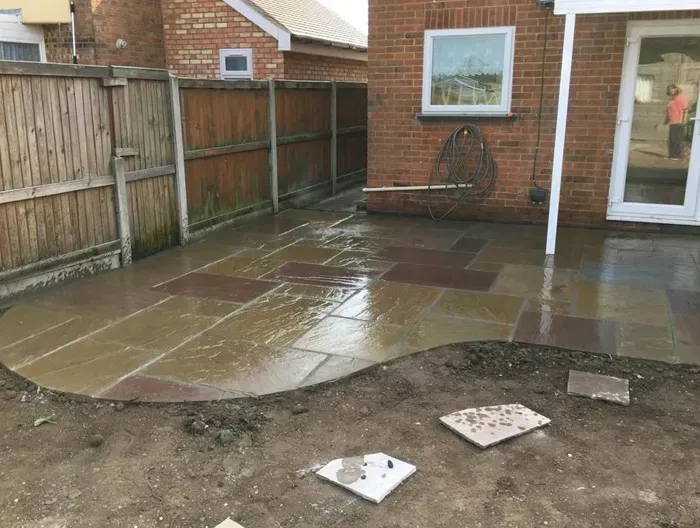
What Happens on the Day & What Affects the Cost
Sealing is straightforward when the weather plays ball, though preparation takes longer than putting the sealer down. A botched clean before sealing simply locks dirt under the treatment.
Typical Step-by-Step Process
- Deep wash & spot treatment: On older patios, we wash off algae and grime and treat ingrained black lichen with a dedicated biocide so the stone is clean right back to its natural grain.
- Full drying window: The stone must be bone dry—including inside the mortar joints. In practice, that usually means washing one day and returning a couple of dry days later to seal.
- Even application: We mask off adjacent brickwork or doors, then apply two coats wet-on-wet using a low-pressure sprayer and microfibre roller or brush, taking care not to leave puddles in natural riven hollows.
- Curing time: Keep people, pets, and garden furniture off the surface for 12 to 24 hours until the treatment cures.
What Drives the Cost?
The price comes down to three things: the total square metres of paving, how much cleaning or black-spot treatment is needed beforehand, and the grade of sealer used. Trade-grade breathable fluoropolymer sealers cost noticeably more per tin than DIY shed brands, because they actually last 3 to 5 years rather than washing out after one wet winter.
When Cleaning & Sealing Is Enough vs Repairing First
If your sandstone slabs sit solid underfoot and the pointing is sound, a thorough clean and breathable seal is all that’s needed to refresh the garden. On the other hand, if slabs are rocking, weeds are pushing up through cracked mortar joints, or rainwater pools against your house wall, sealer won’t solve the underlying problem. Sort out loose flags, re-point the joints properly, and fix any drainage falls first—then seal once the fresh mortar has cured.
Book a Patio Clean, Repointing, or New Sandstone Installation
We work across Canterbury and the surrounding Kent towns with clear written quotes, proper ground preparation, and tidy site handover.
Related Services & Guides
← Back to all paving & roofing guidesIndian Sandstone Patios Canterbury
Elite Paving and Roofing LTD installs beautiful Indian Sandstone patios in Canterbury & Kent. Enhance your garden with durable, natural stone paving. Free quote today!
Do I Need Planning Permission for a Driveway?
Check if a new driveway in Canterbury or Kent needs planning permission: the five-square-metre rule, permeable surfaces and KCC dropped kerbs.
How Much Does a New Patio Cost?
Get realistic per-square-metre patio costs. Learn how excavation, sub-base depth, drainage and waste removal drive prices so you can compare quotes.
How Long Does Garden Landscaping Take?
Realistic timescales for garden landscaping in Kent, and how access, clay soil, wet weather and a KCC skip licence affect the start date.
Do You Need Scaffolding for Roof Work?
Find out when roof work requires scaffolding rather than ladders, how long it stays up, and when you need a Kent pavement licence.
Block Paving Patterns: Which Is Strongest?
Compare herringbone, stretcher bond and basket weave for driveways in Canterbury and Kent, and how edges and a compacted base stop wheel rutting.
Resin-Bound vs Resin-Bonded: What's Different?
Compare permeable resin-bound and non-porous resin-bonded driveways, and what the front-garden five-square-metre drainage rule means in Kent.
How Long Does a Tarmac Driveway Last?
How long a tarmac driveway lasts, what makes edges crumble, and when a front-garden tarmac drive in Kent needs planning permission.
What Is the Best Gravel Size for a Driveway?
Whether 14mm or 20mm angular shingle is best for a driveway, plus depth, membranes, grids, and why gravel can be permitted development.
Is Porcelain Paving Slippery When Wet?
Why outdoor R11 porcelain keeps its grip in the rain, unlike indoor tiles, and how a full mortar bed keeps slabs secure.
Why Do Patio Slabs Come Loose?
Why patio slabs rock or sink (spot-bedding, frost heave and failed pointing), and how re-bedding and repointing fix it.
Does Artificial Grass Drain Properly in Rain?
Learn how perforated backing, granite dust, and a Type 1 sub-base drain heavy rain on Kent clay, plus how to keep pet lawns puddle- and odour-free.
Wooden vs Concrete Fence Posts: Which Lasts?
Timber versus concrete fence posts for rot and wind, and the Planning Portal 1-metre / 2-metre height rules for fences in England.
Signs Your Chimney Needs Repointing or Flashing
Signs of chimney trouble (lifted lead, cracked flaunching, loft damp), and when chimney work in a Canterbury conservation area needs permission.
Can Pressure Washing Damage Paving or Stone?
How high-pressure jet washing can pit sandstone and strip pointing, and safer rotary cleaning and re-sanding methods.
How Soon Can You Walk on and Mow New Turf?
How soon you can walk on and mow new turf, how to check it has rooted, and watering and first-cut tips.
Can You Fix a Leaking Roof From Inside the Loft?
Why internal sealants and spray foam can trap moisture in a loft, and when a roof repair in Kent needs Building Regulations approval.
Can You Put a New Flat Roof Over Old Felt?
When to overlay or strip an old felt flat roof, the risks of trapped damp, and the Planning Portal 25% envelope and 50% roof rule.
Why Is Rainwater Dripping Behind My Gutters?
Why rainwater drips behind apparently clear gutters (perished eaves felt, missing trays and sagging brackets), and how to put it right.
Do Gutter Guards and Hedgehogs Actually Work?
Whether mesh gutter guards and brush hedgehogs actually help with leaves, moss and roof grit, and when hand clearing is better.