How Much Does a New Patio Cost?
By Elite Paving & Roofing Ltd, run by director Jerry Connors
For most homes around Canterbury and Kent, a properly built new patio costs between £120 and £220+ per square metre, supplied and fitted. That figure covers digging out the old ground, hauling away the spoil, compacting a Type 1 sub-base, laying the slabs on a full mortar bed, and pointing the joints.
In real money, a straightforward 20m² back-garden patio usually comes in between £2,600 and £4,400, while a larger 35m²–40m² terrace with drainage channels and steps typically sits around £4,800 to £8,500+. Below is an honest breakdown of where that money actually goes so you can compare quotes properly.
Local Know-How for Canterbury & Kent
- The five-square-metre front-garden rule does not automatically apply to a patio or hard surface elsewhere around the house. The Planning Portal says that, elsewhere around your house, there are no restrictions on the area of land you can cover with hard surfaces at or near ground level, though significant embanking or terracing might need a planning application, and listed buildings need consent. Source: Planning Portal, Planning Portal.
- Canterbury City Council says the district has 97 conservation areas. In a conservation area some external works that would not normally need permission do need it, and Article 4 directions can remove permitted development rights. Source: Canterbury City Council.
“First class from start to finish, Jerry and the team were very professional and most competitive of 3 quotes. Patio left tidy and lads were very polite.”
Related: Patios · Our work in Canterbury
Realistic Patio Cost Guide by Size & Specification
Per-square-metre rates drop slightly on bigger open patios because fixed costs—like hiring a mini-digger, bringing in a skip, and setting up saws—are spread across more ground. Tight side passages or heavy clay soil push the labour hours up. If you are still deciding on slab styles, you can browse what we lay on our Canterbury patio design and installation page.
| Patio Tier (Supplied & Fitted) | Typical Rate / m² | Small (15m²) | Medium (25m²) | Large (40m²) |
|---|---|---|---|---|
| Standard Pressed Concrete / Utility Slabs | £115 – £145 | £1,900 – £2,350 | £2,950 – £3,700 | £4,600 – £5,800 |
| Natural Sandstone / Block Paved Patio | £140 – £185 | £2,300 – £2,950 | £3,600 – £4,700 | £5,600 – £7,400 |
| Vitrified Porcelain / Calibrated Limestone | £175 – £230+ | £2,850 – £3,600 | £4,450 – £5,800 | £7,000 – £9,200+ |
Figures assume normal garden access, 150mm–180mm excavation, a 100mm compacted Type 1 sub-base, full wet mortar bedding, and standard pointing. Brick retaining walls, steps, or long drainage runs add to these totals.
What Actually Drives the Price of a Patio Quote
Two quotes for the exact same size patio can easily be £1,200 apart. Almost every time, the difference is hidden underneath the slabs—in how deep the ground is dug, how the waste leaves the garden, and whether drainage is dealt with properly.
1. Ground Excavation & Access
A proper patio needs digging down 150mm to 200mm below finished height—or deeper if we hit soft topsoil, tree roots, or wet Kent clay. If we can bring a 1-tonne micro-digger through a side gate (minimum 750mm–800mm wide), a 25m² dig takes half a day.
If the only access is through a terraced house or a narrow alley where everything has to be dug by hand and barrowed out, labour time can easily double. Always check how a contractor plans to get spoil out before assuming the cheap quote includes the same depth of dig.
2. Type 1 MOT Sub-Base Depth & Bedding
For foot traffic, we lay a geotextile membrane where needed and compact at least 100mm of MOT Type 1 crushed limestone in layers with a heavy wacker plate. On made-up ground or soft clay, 150mm is safer.
Slabs must sit on a full 35mm–40mm wet mortar bed (plus a brush-on slurry primer on the back of porcelain slabs). Beware of quotes priced noticeably below market rate: corners are usually cut by "five-spot dabbing" mortar onto bare earth, which lets ants, frost, and rainwater crack and rock slabs within two winters.
3. Drainage Channels, Falls & DPC Height
Finished paving should always sit at least 150mm (two brick courses) below your house's damp-proof course and fall away from the building at roughly 1:60 to 1:80 so rainwater never pools by the back door.
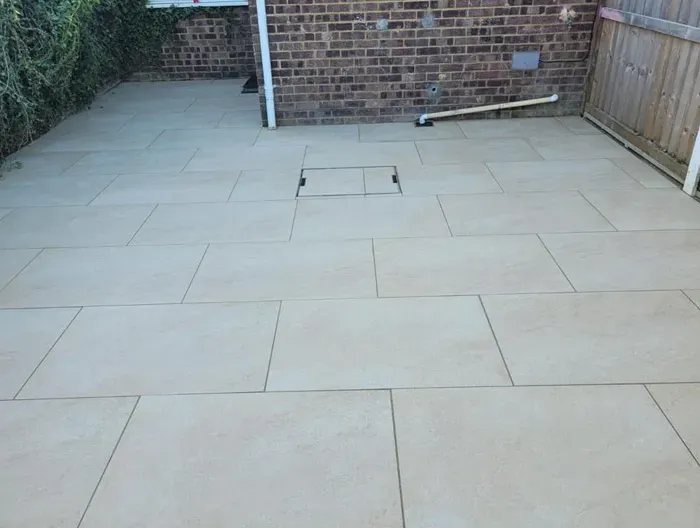
Where garden levels slope towards the house—or you want level threshold access out of bi-fold doors—we install linear ACO-style channel drains piped into a soakaway or surface-water drain, plus recessed tray covers over any inspection chambers so manhole lids blend cleanly into the paving.
4. Waste Removal, Skips & Permits
Digging out 25m² to 175mm produces roughly 4.5 cubic metres of loose soil and old concrete—around seven tonnes once fluffed up in a skip. A single 8-yard skip or grab-lorry load in East Kent typically costs £320 to £450 on its own.
Make sure waste disposal is written into the quote, and check that whoever removes spoil holds a licence on the Environment Agency waste carrier register. If there is no driveway space and a skip has to sit on the public road, a Kent highways skip and scaffold licence is also required.
5. Steps, Edging & Detail Cutting
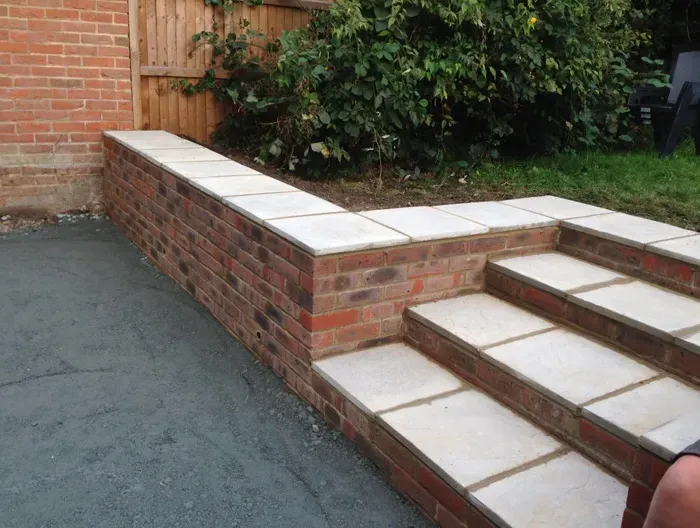
A square rectangle of paving against a straight house wall is fast to lay. What adds days—and cost—are curved borders, bullnose step treads, brick retaining walls on sloping plots, and cutting slabs tightly around drainpipes and bay windows.
Porcelain in particular is dense and hard; every cut needs a water-cooled diamond blade rather than a quick tap with a bolster chisel, and wastage on diagonal or stepped layouts is higher.
When a Repair Is Enough vs Full Replacement
Not every tired patio needs ripping out and starting again. Before we price a new installation, we always look at what the existing base is doing underneath:
A repair & repoint is usually enough when:
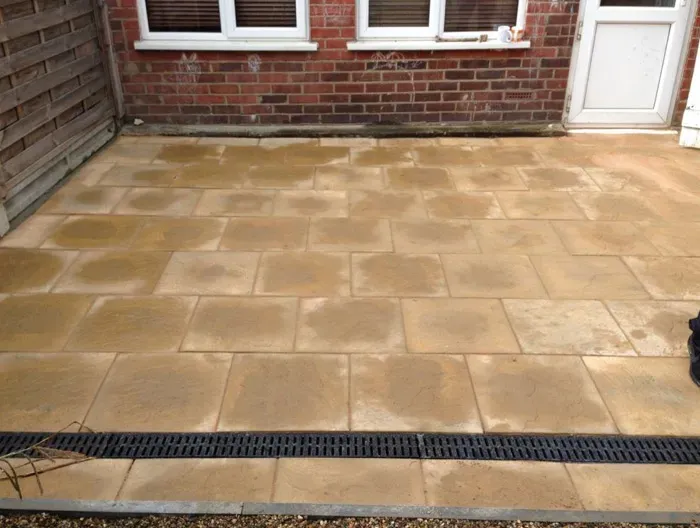
The slabs sit solidly underfoot with no rocking, water runs cleanly away from the house, and the only issue is cracked pointing, weeds in the joints, or one or two loose edge stones. A deep pressure wash, raking out failed mortar, and repointing with brush-in resin or gun-injected mortar costs a fraction of a replacement.
Full replacement is the honest answer when:
Multiple slabs wobble or sink after rain, water puddles against the house brickwork, or an old patio was laid too high and bridges the damp-proof course. Lifting and re-bedding spot-dabbed slabs onto an old failing base rarely lasts; digging out and laying a fresh Type 1 foundation is the only lasting fix.
What Happens on Site & How Long It Takes
A straightforward 20m² to 30m² patio typically takes 3 to 5 working days from strip-out to final wash-down. Here is what a normal week on site looks like and how we keep disruption down:
Protection & Excavation
We lay down boards along barrow routes to protect lawns and paths, mark out falls with string lines and a laser level, and dig out old paving and spoil down to firm ground.
Sub-Base & Drainage
MOT Type 1 aggregate is barrowed in, graded, and compacted in layers with a plate compactor. Linear channel drains, recessed inspection covers, and kerbs are haunched in concrete.
Bedding & Wet Cutting
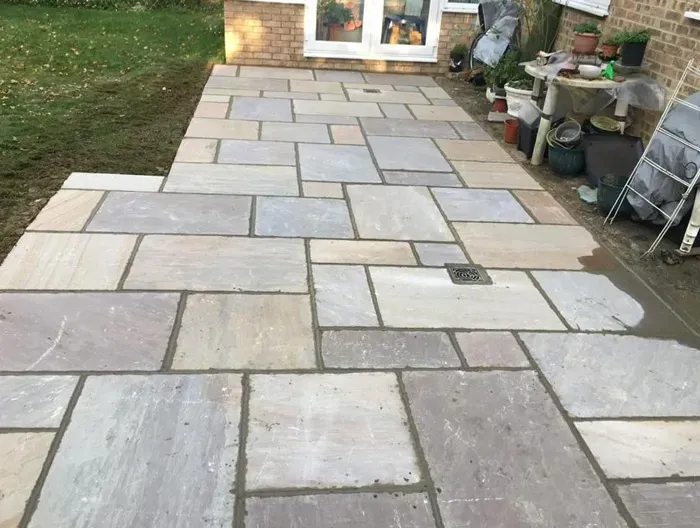
Slabs are laid on a full wet mortar bed (with SBR slurry bond on porcelain), tapped down to string lines for consistent falls, and cut cleanly with a dust-suppressed diamond saw.
Pointing & Tidy-Up
Once the bed has set, joints are pointed cleanly, surfaces washed down, and all off-cuts and bags cleared. Give the mortar 48 hours before putting heavy garden furniture back on.
How to Compare Patio Quotes Fairly
Before signing off on any estimate—ours included—check that these six points are written down in black and white:
- ✓ Exact excavation depth and Type 1 sub-base thickness
- ✓ Full mortar bed specified (never spot-dabbed)
- ✓ Muck-away, skip hire, and any road permit included
- ✓ Fall direction, DPC clearance, and drainage channels listed
- ✓ Jointing method named (sand & cement, slurry, or resin)
- ✓ Clear total price with VAT and written workmanship guarantee
Want an Exact Written Price for Your Garden?
We visit properties across Canterbury and East Kent to measure up, check drainage levels and access, bring slab samples if helpful, and send over a clear, itemised quotation—backed by our 5-year workmanship guarantee.
Related Services & Guides
← Back to all guidesPatios Canterbury
Transform your garden with stunning patios in Canterbury & Kent. Elite Paving and Roofing LTD design and install porcelain, natural stone and block paving patios. Get your free quote today!
Do I Need Planning Permission for a Driveway?
Check if a new driveway in Canterbury or Kent needs planning permission: the five-square-metre rule, permeable surfaces and KCC dropped kerbs.
How Long Does Garden Landscaping Take?
Realistic timescales for garden landscaping in Kent, and how access, clay soil, wet weather and a KCC skip licence affect the start date.
Do You Need Scaffolding for Roof Work?
Find out when roof work requires scaffolding rather than ladders, how long it stays up, and when you need a Kent pavement licence.
Block Paving Patterns: Which Is Strongest?
Compare herringbone, stretcher bond and basket weave for driveways in Canterbury and Kent, and how edges and a compacted base stop wheel rutting.
Resin-Bound vs Resin-Bonded: What's Different?
Compare permeable resin-bound and non-porous resin-bonded driveways, and what the front-garden five-square-metre drainage rule means in Kent.
How Long Does a Tarmac Driveway Last?
How long a tarmac driveway lasts, what makes edges crumble, and when a front-garden tarmac drive in Kent needs planning permission.
What Is the Best Gravel Size for a Driveway?
Whether 14mm or 20mm angular shingle is best for a driveway, plus depth, membranes, grids, and why gravel can be permitted development.
Is Porcelain Paving Slippery When Wet?
Why outdoor R11 porcelain keeps its grip in the rain, unlike indoor tiles, and how a full mortar bed keeps slabs secure.
Should You Seal an Indian Sandstone Patio?
Whether to seal an Indian sandstone patio against lichen, stains and frost, when to wait after laying, and matte versus colour-enhancing sealers.
Why Do Patio Slabs Come Loose?
Why patio slabs rock or sink (spot-bedding, frost heave and failed pointing), and how re-bedding and repointing fix it.
Does Artificial Grass Drain Properly in Rain?
Learn how perforated backing, granite dust, and a Type 1 sub-base drain heavy rain on Kent clay, plus how to keep pet lawns puddle- and odour-free.
Wooden vs Concrete Fence Posts: Which Lasts?
Timber versus concrete fence posts for rot and wind, and the Planning Portal 1-metre / 2-metre height rules for fences in England.
Signs Your Chimney Needs Repointing or Flashing
Signs of chimney trouble (lifted lead, cracked flaunching, loft damp), and when chimney work in a Canterbury conservation area needs permission.
Can Pressure Washing Damage Paving or Stone?
How high-pressure jet washing can pit sandstone and strip pointing, and safer rotary cleaning and re-sanding methods.
How Soon Can You Walk on and Mow New Turf?
How soon you can walk on and mow new turf, how to check it has rooted, and watering and first-cut tips.
Can You Fix a Leaking Roof From Inside the Loft?
Why internal sealants and spray foam can trap moisture in a loft, and when a roof repair in Kent needs Building Regulations approval.
Can You Put a New Flat Roof Over Old Felt?
When to overlay or strip an old felt flat roof, the risks of trapped damp, and the Planning Portal 25% envelope and 50% roof rule.
Why Is Rainwater Dripping Behind My Gutters?
Why rainwater drips behind apparently clear gutters (perished eaves felt, missing trays and sagging brackets), and how to put it right.
Do Gutter Guards and Hedgehogs Actually Work?
Whether mesh gutter guards and brush hedgehogs actually help with leaves, moss and roof grit, and when hand clearing is better.